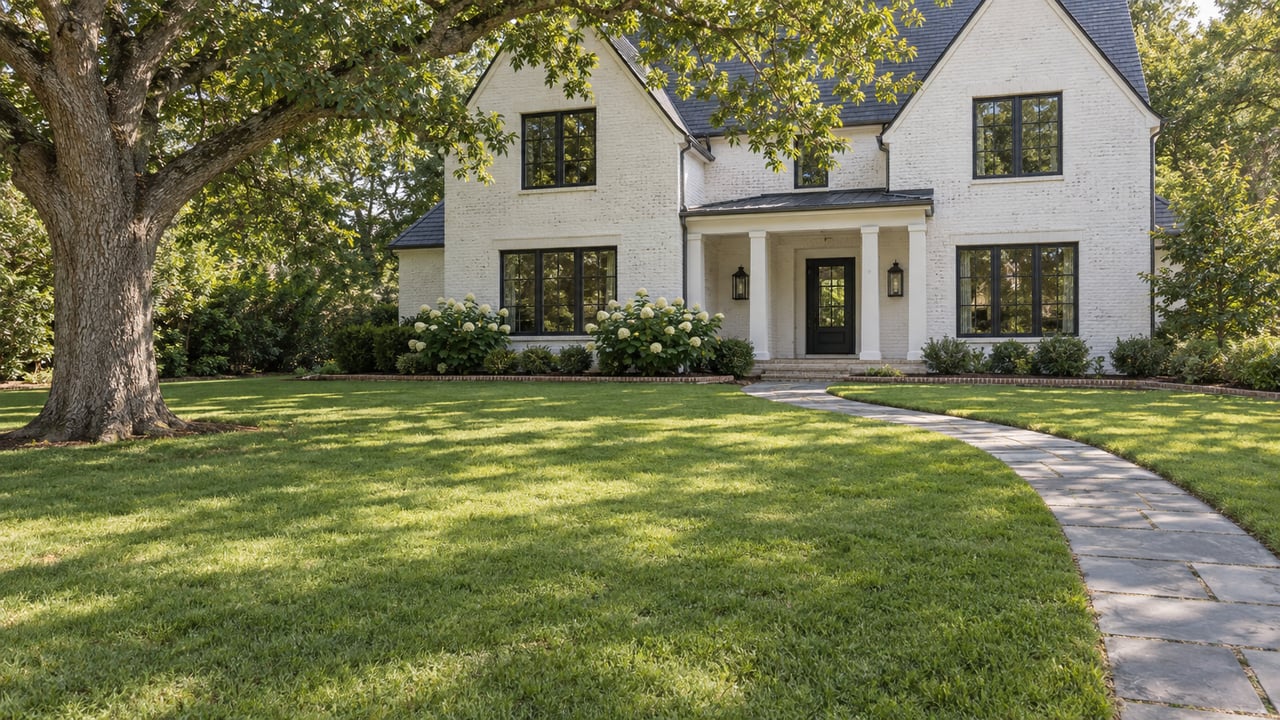
In Buckhead, You're Not Bidding on the House. You're Bidding on the Lot Underneath It.
October 1, 2026
October 1, 2026
In June 2026, a deed recorded in Fulton County closed a $6.35 million sale on a parcel near Chastain Park. The county's own records still classified the land as vacant. The house on it, a brand-new build, had never appeared on a listing site. No sign, no open house, no public asking price. Just a finished home changing hands for millions while the paperwork hadn't caught up to what had actually been built.
That single closing, tracked in Buckhead.com's first-half 2026 market report, is a useful entry point into how this neighborhood actually prices real estate. The report combined FMLS closed sales with deed research across Fulton, Cobb, and DeKalb counties through June 30, 2026, with deeds recorded as late as July 10 folded in. The report's count put the share of Buckhead's highest-priced sales that never touched a public listing at 20.7 percent. The report calls that share conservative, since late-recorded deeds tend to push it higher as more paperwork lands.
If you're comparing Buckhead to another Metro Atlanta neighborhood using whatever median price a portal shows you, that missing fifth matters. It means the top of this market is thinner and quieter than the visible data suggests, and it means the thing actually being priced in a lot of these transactions isn't the house at all. It's the ground it sits on.
A few of the off-market closings from that same half-year window make the pattern concrete. 3785 Paces Ferry Road NW closed for $8,250,000 with no MLS listing. 3470 Tuxedo Road NW, a Woodhaven Estates property on one of Tuxedo Park's established lanes, closed for $7,500,000 in February without a single day on the market. The Stella Drive property near Chastain Park closed for $6,350,000 as what the report describes as a finished product with zero public marketing.
Set those against the sales that did list. 4725 Northside Drive, brand-new 2025 construction on a Tuxedo Park street, architecture by William T. Baker with interiors by SOURCE and construction by Cole Construction, sold for $9,292,500 after a public listing. 439 Tara Trail, the 2025 Atlanta Homes & Lifestyles Holiday Show House in Historic Brookhaven, sold for $5,995,000, working out to $773 per square foot, the kind of number a builder wants attached to a name and an address.
Line those two groups up and a pattern shows itself. The homes that listed publicly tended to be the ones built to be seen: architect credits, designer credits, show house status, a story worth telling to a buyer pool that hadn't already found the property. The homes that closed quietly tended to be estate-level transactions between parties who already knew what the address was worth and didn't need a marketing campaign to find each other.
One closing in the report does more work than the rest combined. A European-inspired custom home on roughly two private acres, built by Harrison, sold for $7,840,000 in July 2025. Nine months later, in April 2026, it sold again. Same address. Same price to the dollar. $7,840,000 both times.
That kind of exact repeat isn't typical appreciation math playing out. It reads more like two separate, well-informed parties independently arriving at the same number for the same asset within a short window, without a public listing history to anchor either one of them. In a market where price discovery usually happens through comparable sales that buyers and agents can actually see, a repeat sale at an identical price suggests the ceiling for that specific type of lot, in that specific pocket, was already understood among the people who transact at that level, whether or not it ever showed up in a public dataset.
None of this is unique to Buckhead as a phenomenon, but it's unusually visible here because of geography. Metro Atlanta's teardown and infill market exists in the first place because the most walkable, best-located inside-the-perimeter neighborhoods were built out decades ago. A buyer who wants brand-new construction in one of those neighborhoods generally can't find raw land to build on. The workaround is to buy an older, often smaller house purely as the vehicle for acquiring its lot, then remove the house.
Buckhead is close to the extreme end of that dynamic. Along corridors like West Paces Ferry, Tuxedo Road, and Habersham Road, there is functionally no vacant land left to build on. New construction almost has to come from a teardown.
North Buckhead, the section roughly bounded by Wieuca Road to the south, the Chattahoochee corridor to the west, Roswell Road to the east, and the Sandy Springs line to the north, shows how sharply that plays out on a single street. Original 1960s-1980s brick ranches and split-levels, typically 2,000 to 3,500 square feet on half-acre or larger lots, price in the $600,000 to $1 million range, priced for the land and the location more than for the house standing on it. Homes that have been significantly updated or expanded run $1 million to $2 million. New construction replacing a teardown original runs $1.8 million to $4 million or more. Rickenbacker Drive alone has seen several recent teardown-rebuild projects land in the $2 million to $3.5 million range. Old Ivy Road, a quieter street with larger lots, has seen significant new construction activity of its own. Lake Forrest Drive, which borders the Blue Heron Nature Preserve, commands some of the area's highest per-lot pricing.
Three price tiers, same streets, same zoning, same schools. What separates them is almost entirely what a buyer plans to do with the structure that's currently there.
It's worth being honest about the other side of that math, because a lot's value on paper isn't the same as a lot's value realized. A .92-acre site at 2878 Piedmont Road in Garden Hills shows what a land play looks like when it doesn't go smoothly. The property, a former single-family home turned architect offices next to an adjacent vacant lot, was cleared for new development roughly nine years ago and has changed hands multiple times since. In early 2024, homebuilder Cablik Enterprises put up signage for twelve planned townhomes and started site development. By May 2026, according to Urbanize Atlanta's coverage, the project had stalled again, and the site came back to market asking $5.5 million, still zoned R-4, still just infrastructure and a fence, with no finished product to show for nearly a decade of ownership changes.
That's the risk side of the same coin. A prime address and the right zoning don't guarantee a finished outcome on any particular timeline. Financing, permitting, and market timing all have to line up, and a site can sit through several owners without ever crossing the finish line.
If you're weighing Buckhead against another Metro Atlanta neighborhood, the visible median is a floor, not a ceiling. A meaningful slice of what actually trades at the top happens quietly, closes without a listing, and never feeds into the number a portal shows you.
If you're bidding on an older, smaller home in one of these built-out pockets, the comparable that matters most may not be what similar houses in similar condition sold for nearby. It may be what the lot alone is worth to a buyer who plans to clear it, and those two figures can diverge by hundreds of thousands of dollars on the same street.
If you're selling one of those homes, how you position it changes who shows up. Marketed as a move-in-ready renovation candidate, you draw one kind of buyer. Marketed as a redevelopment opportunity, you draw another, and the number they're each willing to pay can look very different.
And if a site's story includes prior stalled development, ask what's actually recorded rather than what's implied. Permits pulled, site work completed, zoning approvals in hand. The Piedmont Road parcel had all the right ingredients on paper for years without a finished building to show for it.
Does an off-market sale mean the price wasn't tested? Not necessarily. The repeat sale on that same two-acre property at an identical price nine months apart suggests the opposite: buyers transacting at this level in Buckhead often already know recent comparable prices well enough to arrive at the same number independently, listing or no listing.
How would a buyer even learn about an off-market sale? Through the county deed record after closing. These transactions still get recorded in Fulton, Cobb, or DeKalb, even without a public listing history attached to them, which is exactly how the Buckhead.com report was assembled.
If a home is priced near land value, is the structure worthless? No, but the price is set with the expectation that a buyer may substantially rebuild or remove it, so the number reflects the lot's size, location, and zoning far more than it reflects the condition of what's currently standing on it.
Reading a market like this takes more than a portal search, especially when a fifth of Buckhead's highest-priced sales never shows up on one. If you're weighing a purchase or a sale in Buckhead and want a clearer read on what a specific lot or address is really worth, Cheever Home Group is a good place to start that conversation.
With more than 40 years of combined experience, deep local expertise, and a client-first approach, Cheever Home Group delivers personalized guidance, skilled negotiation, and proven results throughout every stage of your real estate journey.